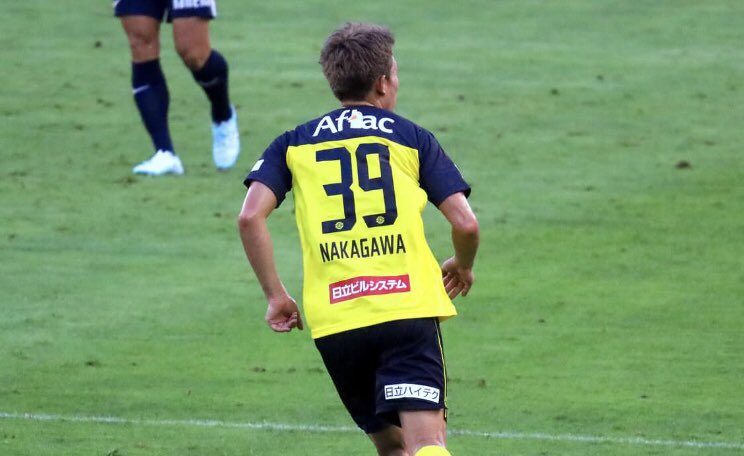
Nobuteru Nakagawa is a 23-year-old Japanese midfielder who plays for Kashiwa Reysol in the J-League. A graduate of Japan’s University system, Nakagawa is a latecomer to professional football, only establishing himself as a first-team regular for Kashiwa in the second half of the J-1 season. But what he has shown in that small amount of time suggests he could take a step up from the J-League.
Nakagawa stands around 5’9″ (1.75 m) with a slight build. Nakagawa is generally deployed as part of a double-pivot in a 3-4-3. His main selling point is his passing ability. Nakagawa consistently breaks the first line of the press. Even more impressively, he is often able to thread the needle with passes on the ground over long distances, so he is usually playing the ball from near the halfway line to a teammate on the edge of the penalty area. This sort of penetrating pass from deep areas is quite useful for Kashiwa. He is also adept at picking out wingers in pockets of space. Over shorter ranges, Nakagawa is good at progressing the ball with quick 1-2s, doing a good job of moving into space to receive a forward pass. Nakagawa is reasonably comfortable passing the ball with his weaker left foot, which allows him to play out of pressure quickly. He is also quite good at turning under pressure, creating the space he needs to play out of danger. All in all, this makes Nakagawa a press-resistant player. However, there is one major exception to this: his first touch is a little bit inconsistent. Most of the time, he does a perfectly fine job of getting the ball under control, but about once in every fifteen times, the ball will absolutely balloon off of his foot. Nakagawa’s final third contributions are limited, mostly because he plays such a deep role. But sometimes his off-ball runs carry him into decent spots in the box. He also takes a fair number of long-range shots and is a decent ball striker. These characteristics, in combination with his vision and passing, could make him more productive if played further forward, in theory. Nakagawa does some dribbling, but he looks a lot more comfortable turning with a player at his back than he does running at a player in space.
Nakagawa generally sits very deep out of possession. He does not leave his position to make defensive interventions very often. But he is quite good at keeping opposition players in his shadow and makes a lot of interceptions. He also does a good job of harassing players who enter his zone, closing them down, and making it difficult for them to do anything. So it may be that his conservatism is a tactical choice to prevent Kashiwa’s double pivot from being overly stretched. There are certainly times when he would be frustratingly slow to close down a shot or cross because he was starting from practically on top of the back three. His pace is middling, so he is not able to cover that much ground that quickly. Nakagawa is also a bit lacking in physical strength, and that limits his effectiveness in fights for loose balls.
Nakagawa is a very strong ball progressor with above-average defensive contributions. There is some evidence that he could provide greater offensive outputs with a more attacking role. But even if that is not the case, his effectiveness in a double pivot is more than enough to recommend him for a modest step up from the J-League. Belgium is a common landing spot for Japanese players in Europe, and I think Nakagawa could contribute to a top-half team in that league.
 Target Scouting