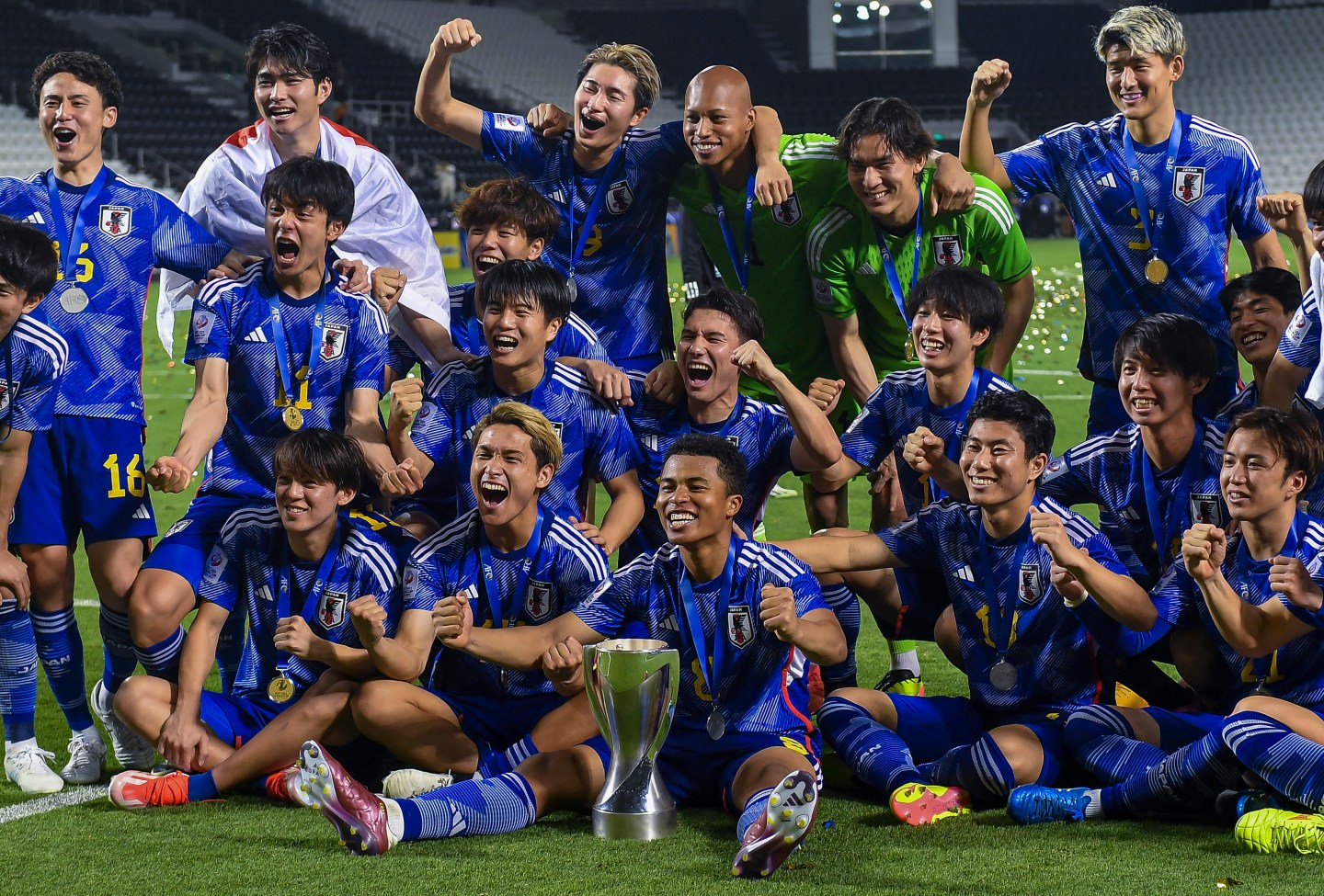
During April and May Qatar hosted the 6th edition of the AFC U23 Asian Cup with three spots at the Olympics in Paris at stake. Caleb Wilkins and Aidan McHenry profile their standout players of the tournament below:
Thailand
Teerasak Poeiphimai/CF/Port F.C/2002
Teerasak Poeiphimai was able to distinguish himself at this tournament despite Thailand’s generally poor play and his not being a nailed on starter. Poeipimai is a striker but often drops off to link play. He is 5’9 and not much of a physical presence so he relies on technical ability and intelligence to have an impact. Poeiphimai was very effective at playing in his wingers and created a lot of chances for them throughout the tournament. He consistently played simple but effective through balls or layoffs to teammates in space. He also had quite good off-the-ball movement, usually ending up unmarked in dangerous areas. The Thai team was not very good at getting the ball to him but there were a lot of times where he was standing alone in the box and better players might have gotten the ball to them. Actual opportunities to shoot the ball were few and far between but Poeiphimai did have a couple of high-danger chances that he was not able to convert. There is a bit of a caveat to saying that Poeiphimai has good movement. He is very adept at getting free of defenders but he moves like someone with only a vague understanding of the offside rule. He timed runs in behind poorly and was often caught offside. His first touch is also a bit mediocre and that undercuts his ability to link play. Poeiphimai has an outrageously good goal scoring record in Thai football (though he doesn’t seem to be a nailed on starter there either) and he has some definite plus skills. So it seems reasonable that he could move to a higher level. However his poor physical profile and mediocre touch will probably hold him back from the highest level. Japan probably makes the most sense for him, since they have carveouts in their foreigner limits for ASEAN players, but he might have a better chance of making an impact in J2 rather than J1.
Tajikistan
Amdoni Kamolov/W/Istiqlol/2003
Amdoni Kamolov played every minute as a winger in this tournament and registered 3 assists as Tajikistan went out in the group stage. Kamolov does two things, he cuts inside and he works really hard. Kamolov is right footed and played off the left for the most part. He has good vision and is very good at combining with teammates or playing balls in behind. He’s a quick thinker and is able to take advantage of brief openings. Kamolov is a strong 1v1 dribbler with good close control. However he is a bit lacking in pace so sometimes he would send a player the wrong way but wouldn’t be quite quick enough to get away. In addition to shorter combining passes he is also a good crosser. He can put in deliveries that had a lot of dip and swerve on them, creating some problems for opposing defences. One slight concern I have, in addition to his middling pace, is that Kamolov does not take a huge amount of shots for a winger. That does give me a little bit of pause about his ability to be an impact attacking player at a higher level. Kamolov also puts in a tremendous amount of defensive work, regularly tracking back and hassling opponents off the ball. I’m not 100% confident he defends well enough that you might consider converting him into a wing-back however. It not necessarily sophisticated defending, just intense hustle. Kamalov plays his football in Tajikistan after bouncing around in the lower reaches of Spanish football. I think a step up in eurasia would make a lot of sense for him. The few Tajik players who play abroad seem to mostly play in the Uzbek league and I could definitely see Kamolov having success there.
Shakhrom Samiev/CF/FK Andijon/2001
Shakhrom Samiev played as a striker for Tajikistan and scored once. Samiev is the ideal striker for a strong team in a low level league. He has a great physical profile and enough skill to bully low level defenders. Samiev is 6’0, strong, and plays a very physical game. He is good in the air and good at using his body to protect the ball. Samiev also has a little bit of pace and can get in behind defences reasonably well. He also has a surprising amount of technical ability. He can run with the ball and has enough dribbling ability to trouble defenders. That said, his first touch is a bit bouncy and that can limit his ability to hold the ball up. Samiev also has some level of passing ability and can play in teammates. He generally makes good decisions in transition situations (which was the main way Tajikistan got chances). I do think his movement in the box could be a little better. He rarely got shots from the ultra high danger areas. He mostly got his shots from wider areas of the penalty area through his physicality or through headers from around the penalty spot. This might be mitigated by being on a team that was stronger relative to the competition but it does suggest limitations to his game. Samiev has already played for a ton of clubs in various low levels in Europe and Asia, mostly scoring at a respectable rate. He has just landed at FK Andijon of Uzbekistan where he already has a goal and an assist in three appearances. If he can keep up something close to that pace I think another step could be possible, perhaps to a mid-tier European league.
Rustam Soirov/CF(W)/Istiqlol
Rustam Soirov played as a striker and as a winger for Tajikistan in this tournament and scored twice (though one of these was a penalty). Soirov sits on the shoulder of the last defender and tries to get in behind. That’s how he got pretty much all of his chances in this tournament. Soirov is fast and is very good at finding channels to run into. He often makes runs across the back shoulder of a defender and generally goes undetected. The problems for Soirov begin when you look at anything other than his ability to make runs in behind. Soirov is very small standing 5’6. So he’s not winning many aerial duels or physical battles. His first touch and technical ability is also below average. So he’s not very good at dribbling and some of his decision making was also not very good. Soirov was often shunted out to the wing but his technical limitations were really emphasised there so I think playing through the middle is where he is most likely to be successful. But, despite his very limited skillset, Soirov consistently used the ability he does have to get dangerous chances in this tournament. He also has a very strong goal scoring record in the Tajik, Uzbek (2nd tier), and Estonian (2nd tier) leagues at club level. So I do think it’s possible he could take another step if he’s put in the right situation. Obviously this is not a player I would back to reach the highest level of football but he could certainly do some damage in lower European leagues or at a slightly higher level within Asia.
Jasurbek Jaloliddinov/AM/Neftchi/2002.
Jasurbek Jaloliddinov played in the #10 role in this tournament. He has also played deeper in his career but Uzbekistan seemed to always want him right behind the striker, preferring to drop generational talent Abossbek Fayzullaev deeper when faced with the choice. Jaloliddinov has the ability to pull some magic with his passing. He has good vision and loves a long diagonal through-ball. He’s left footed which allows him to deliver the ball from different angles than defences may be expecting. Despite his passing ability, Jaloliddinov was not that involved in build up play. He tended to only get involved at the end of moves. He can also create chances for himself with his off-the-ball movement, he regularly receives the ball in the box after making himself available. However, he can be a bit wasteful with the ball. He’s not a great dribbler and his very small so he is often knocked off the ball fairly easily. This is mitigated somewhat by his ability to win fouls. He seemed to be kicked almost constantly. Jadoliddinov was certainly willing to track back but his defending was not particularly sophisticated. He would go flying into tackles that looked like they were straight out of a Sunday league compilation. Jaloliddinov may not be the most well rounded or dynamic player of all time but is pretty consistently involved in shot creation so I think a step up from the Uzbek league is definitely possible. For players from Uzbekistan this step up tends to be Russia which is a bit of a career dead end given current geo-political affairs. But based on players who have been successful going there in the past it seems pretty clear to me that Jalodiddinov could have an impact for a smaller team in the RPL or teams of a similar level elsewhere in the world.
Khusayin Norchaev/CF/Neftchi (on loan)/2002
Khusayin Norchaev played as a centre-forward for Uzbekistan in this tournament. Norchaev is very much a link-up player. He drops off the opposing backline to receive the ball between the lines and then look to play in teammates. Norchaev is very strong which makes him effective at holding the ball up and turning even under significant pressure. His passing stands out compared to other players at this tournament giving him the perfect skillset to play his role. Norchaev is fairly quick though he does not have elite speed. A lot of the chances he got for himself in this tournament were simply the result of getting to a loose ball quicker than anyone else. His speed also means he is a threat to have a ball played in behind for him. The fact that he has this tool in his locker makes him a real handful for defenders. His first touch and technical ability, while not elite, are above average and help Norachev hold onto the ball. If he has a weakness it’s probably his box movement and ability to get free for cutbacks and crosses. Most of his shots are picking up loose scraps, he didn’t demonstrate the ability to shake a marker with change of direction in his run. Norchaev is currently on loan back to the Uzbek league after Russian second tier side Alania Vladikavkaz signed him and then only played him for 300 minutes across two seasons. It’s pretty obvious that he can play at a higher level than the Uzbek league but his current situation makes it a bit hard to know who to recommend him to. Is his parent club willing to give him another chance? Would they sell him? If so, to whom? Perhaps he could follow his teammate Khojimat Erkinov to one of the gulf leagues. I certainly think he could make an impact in a mid tier european league if it’s possible to make that sort of transfer work.
Ali Al-Mosawe/W/Estrela/2002
Ali Al-Mosawe played as a right-winger for Iraq in this tournament. However, it was pretty clear to me that he could be more effective elsewhere. Al-Mosawe has mostly strong technical ability. He can beat players 1v1. He’s quite shifty once he has the ball under control and he has a low centre of gravity which makes him hard to knock off the ball. He can split lines with his passing. He often drifted centrally to try and make things happen. He did not create a lot of high danger chances but he was able to break the midfield lines of opponents. Although Al-Mosawe gets a fair number of shots from just inside or outside the penalty area, he does not get a huge amount of high danger shots. All these things considered, it seems pretty clear to me that Al-Mosawe should be converted into a box-arriving #8. He doesn’t quite have the offensive juice to play in a front three but his technical and physical ability still brings a lot of value. Al-Mosawe was quick to close down opponents and a strong tackler thanks in part to his physical strength so he could probably handle more defensive responsibility. However, one major drawback is that Al-Mosawe’s first touch is not very strong. So you would have to live with some giveaways in the centre of the park. Al-Mosawe currently plays reserve football in Portugal after having played at youth level for F.C Copenhagen in Denmark. He’s 22 so the Portuguese first tier probably isn’t going to happen. But a return to Scandinavia, perhaps to Sweden or Norway and a change of position could see him have a successful career.
Vietnam
Thai Son Nguyen/CM/Thanh Hoa F.C/2003
Thai Son Nguyen was largely deployed as a #8 by Vietnam in this tournament. He impressed me with his ability to progress the ball with his passing. Nguyen rarely played flashy passes but he was consistently able to pick out 10-15 yard forward passes, breaking the opposing midfield line when the option was on. Often, the forward pass was not on as Vietnam’s attacking movement was extremely impotent. However in these situations Nguyen was usually at least able to keep the ball. Although he mostly kept things simple he did have a few defence splitting through balls as well. This leads me to believe that he could be a more constantly progressive passer with better teammates. He rarely lost the ball due to a bad first touch. Nguyen is not the Vietnamese Kante but he was reasonably strong in defensive duels and would always put in the effort to at least close down an opposing player. Because he was deployed as a #8 in a midfield three he was able to press higher up the field to make defensive interventions. However I think he could also be effective in a double pivot thanks to his defensive positioning. Nguyen did not display very much ball carrying ability in this tournament, he is almost exclusively a passer. Nguyen also does not have very much to recommend him physically. He did not strike me as particularly fast and he is very slight, usually coming off second best in any duel that was purely based on strength. Nguyen strikes me as a player who would be helped considerably by playing in a stronger team and I think he can definitely make a step up from the V League. I wouldn’t be 100% confident in recommending him to a K or J League team based on this tournament (though I think he showed the potential to eventually reach that level) but he would be a smart gamble for teams lower down the pyramid in those countries or perhaps for A-League teams (though this would probably have to be on a free transfer so it’s dependent on his circumstances).
Indonesia
Witan, RW, Persija Jakarta, 2001
Witan has already tried his talent in Europe and returned home, but there is still potential in his skillset, as evidenced by his performances as a left footed right winger in this tournament. Although he played as a right winger in formation, he played more of an inside forward from the right role, preferring to operate/attack from the middle channel, shadowing the striker and flashing short for ball. Physically, he is quite short at 1.7 m with a lean frame. Despite his build, Witan does not shy away from physicality and puts in high effort to put in stand tackles in the high press. To pair, this athleticism helps him in his contact balance and press resistance on the dribble when attacking. This makes him a technical dribbler with bursts of pace that force markers to foul him at an unusually high rate. His ability to draw fouls when progressive carrying with his immense pace into ground passes forward or inside to create and/or distribute. He did not display much end product and over dribbles at times. His decision making and finishing threat must improve should he have the ambition to return to Europe/go abroad. His strengths as an athletic progressive carrier and high work rate presser should take him to higher levels in the future.
Justin Hubner, CB, Wolverhampton/Cerezo Osaka, 2003
Hubner put his defensive capabilities and leadership on display for Indonesia. He was a rock at the back, mainly playing as a left-sided or middle centre back, marking quite well off the ball. This was exemplified by agility in his movements to retreat after ball movement, as he stays on his toes in his defensive stance, even off ball, keeping his head on a swivel, with eyes on marker and possession. This awareness, especially in the box, had him ready to roll out and cover the wing or in one impressive moment, block multiple shots in a row to single-handedly stop danger in the box after a corner. Impressive solo defensive efforts represented his defensive exploits well, like tracking back down the middle channel to be in the passing lane and intercept passes through. His main weakness as a defender was his aggression, because although he closed space quickly and imposed his presence early in 1v1s, it led to some hard fouls. His stand tackling is usually put in using his frame and strength, whereas his slide tackles came in as last-ditch efforts, especially during recoveries, with a mixed bag of results. For the most part he aided himself in closing off angles for passes/crosses with these movements but at times he was a bit late and allowed too much space for this distribution to create danger. In the buildup, since he mostly operated in a back three, he was not too involved in progression, but his distribution was mostly laterally with his dominant left foot. On ball, Hubner was composed even with pressure in his face, but his decision-making needs work as there were simple passes and clearances that were not made or blocked/intercepted. In all, the centre back who operates best from a back three is a solid defensive-minded player with some potential as a distributor as a left footer.
Japan
Kota Takai, CB, Kawasaki Frontale, 2004
Takai is a tall 1.93 m centre back with a broad and muscular frame that is mature for his age and height. He mainly played on the left side of defence but is right footed and comfortable in distribution from the back. Takai used his frame to his advantage often, using long strides to cover space on recoveries despite not being the quickest due to his size. His instincts defensively helped him off the ball often, tracking back and anticipating passes through to intercept, either using his head to win dominantly with his height, as jumping into aerial duels was not always necessary for him. Overall, he was dominant in duels because of his size, mostly in the air. On the ground, his timely and physical tackles, mostly standing, usually resulted in a ground duel win due to his body control to use his frame to win possession back. Due to his physical approach to duels and aggression to step up in anticipation of passes to his marker/zone, fouls are a natural part of his game. As Takai grows into his body, these will become fewer in number. The more secure he is in his defensive 1v1s the better, given his instinctual and aggressive style to step up and engage in duels first. On the other side, Takai was a key and active member during progression in the buildup. He mostly ground passed short forward up the left wing and middle channel and to his sides, mixing in a chip pass through here and there. His composure and scanning on the ball give way to a profile that will only become more involved in the buildup. With accurate and reliable distribution as such a large player, even under pressure, Takai brings a lot of value to a back line. A star in this tournament as one of its younger players, do not be surprised if a German or Italian club comes calling soon.
Takashi Uchino, LB/RB,Fortuna Dusseldorf, 2001
Uchino is a natural right back that played as an inverted left back in this tournament, captaining his nation against rival South Korea. He already has moved to Europe, as he has been based in Germany since 2018. On the attack, he provided wing distribution, mainly creating inside using his right foot. Those passes inside when angled from the wing into the box helped create chances to underlapping runners in stride on several attacks. Before creating chances or providing his reliable ground distribution on back and interior passes, Uchino was quite calm on the ball, lining up markers for 1v1s to cut inside with a turn of pace or stand on ball scanning into a pinpoint entry pass. Defensively, he was a bit hasty engaging in duels, leading to some hard fouls. Outside of fouls coming up in anticipation or on the odd hard tackle, Uchino could be relied upon defending the wing, locking up his 1v1 matchups. His recovery pace allowed him blocks of crosses using his body or when sliding. In 50/50 duels, he positioned his body well to either box out a marker for a teammate to grab possession or to step in with a timely lunge to get possession for himself, sometimes over pursuing as he went with instincts. When marking off the ball, he was attentive sticking to his man at the back or front post with head occasionally swivelling. This was something he kept up on his recoveries that allowed him to pick out interceptions or block crosses. Uchino may be a full back that provides valuable depth on a Bundesliga roster soon based upon his exploits at this cup.
Yu Hirakawa, LW, Machida Zelvia, 2001
Hirakawa impressed with his attacking play from the left wing for Japan as a creative threat who is quite pacy. He stands at 1.72 m with a lean frame, making his pace much more important due to his lack of natural strength/physicality. On the ball, this is where he excelled the most. His control on the dribble combined with pace earned him respect form his markers in 1v1s. This combination allowed him two consistent ways to cut inside into space to create. The quality and technique of his right foot did not stop after the dribble. Hirakawa put in a high volume of in swinging crosses from the left, often stirring up danger in the box. To pair with his dangerous crossing, he was able to put his distance finishing on display, too. Although he lacked goal contributions during this competition, his creative and finishing threats were constant. His confidence and ability to pull the trigger from outside the box on crosses and shots made Hirakawa someone the defence could hardly forget about. Off ball, he showed short for the ball or made pacy runs up the inside left wing on the counter. His flexibility to be comfortable doing both bodes well for his fit at higher levels. In terms of defensive work rate, his was high for a winger. Hirakawa tracked back down the wing often, applying pressure from behind and occasionally winning possession using his quickness and impressive timing to put in a challenge. His crossing and dribbling abilities mesh with his pressing effort for an under-the-radar, must-sign winger.
South Korea
Tae-seok Lee, LB, FC Seoul, 2002
Lee played an important role for South Korea as a wide playmaker, set piece creator, and wing defender. Beginning with his physical profile, he stands at 1.74 m with a lean frame similar to Hirakawa alongside above average pace. On the attack is where much of his output came. He had an assist from a cross via a corner, an example of his set piece delivery quality and a precursor to his crossing accuracy and volume from wide. Supporting the attack with mixed runs and timing them well to get in behind, especially when wide and/or overlapping, put Lee in positions to put his crossing to proper use. After receiving in stride, it was common to see him display a bit of flair on the dribble to gain space from his marker prior to swinging in his cross if not crossing quickly or first time. His volume of crosses was key, as his accuracy was inconsistent in some appearances. Defensively, Lee was solid and did not allow too much space to operate in 1v1s. He defended conservatively on the wing, operating within his limitations and not taking many risks going into duels. Off ball, his marking was reliable and was rarely caught out by runs in behind. In his own half, Lee is an average contributor, but on the attack his crossing tendencies and creative traits paint a wide profile that could have European clubs lining up for him.
 Target Scouting